
Daily writing prompt
If you started a sports team, what would the colors and mascot be?


Rainbow across the world, wherever spotted, has the colors which we an acronym, called VIBGYOR. I would like to have these colors of Rainbow.
Rainbow across the world, wherever spotted, has the colors which we an acronym, called VIBGYOR. I would like to have these colors of Rainbow.
In a courtroom, the atmosphere is electric. Lawyers argue with full force, dismantling each other’s logic, dissecting evidence, and advocating passionately for their clients. To an outsider, it looks like war. Yet, when the gavel falls, these same adversaries often shake hands, share compliments, and share a meal.
How is this possible? Because the legal profession understands a fundamental truth that the corporate world has largely forgotten: Debate is about ideas, not egos.
Contrast this with the modern boardroom. In many organizations, managers shy away from strong debate, fearing political backlash or personal friction. Leaders, rather than acting as impartial judges who solicit diverse viewpoints, often prioritize consensus over truth. The result is a culture of “artificial harmony”—a polite silence that breeds Groupthink, diluted decisions, and missed opportunities.
It is time for corporate leaders to take a page from the courtroom playbook.
The Courtroom Model: Why It Works
The legal system is designed to produce the truth through conflict. It succeeds because it relies on structural safeguards that most businesses lack.
1. Codified Rules of Engagement
In a courtroom, everything runs on clear and strict rules. Lawyers know they must challenge ideas, not attack people. Personal insults—what we call ad hominem attacks—are not allowed. Every claim must be backed by solid evidence. These rules create a safe and structured space for debate. Arguments can be intense because the stakes are high, but the process ensures that no one feels personally threatened. It’s a system designed to protect respect while allowing intellectual rigor to flourish.
Now contrast this with many corporate settings. In boardrooms, the rules are often unwritten and inconsistent. Instead of attacking the idea, discussions sometimes slip into attacking the person who proposed it. Criticism becomes personal, and judgments are made on the individual’s perceived intent rather than the merit of the argument. This discourages open dialogue and creates a culture of caution, where employees nod in agreement rather than speak their minds. When debate feels unsafe, innovation suffers, and decisions are driven by politics rather than logic.
Real-world examples show the cost of this behavior:
These cases prove that when corporate debate becomes personal—or worse, political—the organization pays the price in lost innovation, ethical breaches, and even catastrophic failures.
2. Respect for the Opposition
In law, a strong opposing counsel is never seen as an enemy; they are an essential pillar of justice. Their role is to challenge, probe, and test every argument so that the truth can emerge through rigorous examination. Without a vigorous counter-argument, the system risks becoming biased or complacent. The purpose of advocacy is not to silence the other side or undermine their credibility—it is to present a superior case that can withstand scrutiny from every angle. This adversarial process ensures fairness, sharpens reasoning, and ultimately strengthens the integrity of the outcome. In fact, the presence of a formidable opponent is what elevates the quality of justice, because only through robust debate can the strongest ideas prevail.
The same principle applies in corporate decision-making. A strong challenger in the boardroom is not a threat—they are a safeguard against blind spots. Consider Amazon’s leadership principle, “Have Backbone; Disagree and Commit.” Leaders are encouraged to challenge decisions respectfully, even when uncomfortable, because Bezos understood that innovation thrives on friction. Similarly, Satya Nadella transformed Microsoft’s culture by inviting dissent and valuing diverse perspectives, turning internal rivalry into constructive dialogue. When opposing views are welcomed, strategies become sharper, risks are mitigated, and decisions stand the test of scrutiny.
Contrast this with companies like Nokia, where dissent was punished, and critical voices were sidelined. The absence of healthy opposition led to missed opportunities and eventual decline. Just as justice depends on strong opposing counsel, corporate success depends on leaders who see challengers as partners in progress—not adversaries.
3. The Neutral Arbiter
Perhaps most importantly, there is a Judge. The Judge’s role is not to be the smartest person in the room, nor to force everyone to agree. Their responsibility is to ensure the process is fair, to listen actively, and to render a decision based on merit rather than hierarchy. Judges mediate, clarify, and create space for both sides to present their strongest arguments. They don’t dominate the discussion—they orchestrate it.
Imagine if corporate leaders acted the same way. Instead of behaving like captains demanding loyalty or pushing their own agenda, leaders could serve as impartial facilitators—encouraging robust discovery, weighing evidence, and ruling based on logic rather than politics. Unfortunately, in many organizations, leaders remain silent during debates or, worse, take sides prematurely. This silence or bias kills healthy conflict and signals to employees that speaking up is risky.
Examples of Leaders Acting Like Judges
Satya Nadella at Microsoft : When Nadella took over as CEO, he shifted Microsoft’s culture from internal rivalry to collaboration. He encouraged open dialogue and created psychological safety, famously saying:
“Our industry does not respect tradition—it only respects innovation.”
He listened actively, weighed ideas, and made decisions based on merit, not politics. This judge-like approach revived Microsoft’s growth.
Indra Nooyi at PepsiCo : Nooyi was known for her inclusive leadership style. She invited diverse viewpoints and mediated discussions to reach balanced decisions. Her approach reflected a judge’s mindset—ensuring fairness and respect while driving strategic clarity.
The Corporate Reality: Why Logic Dies in the Meeting Room
There is a strange paradox in corporate life. If you take a team out for drinks or tea, they will debate sports, politics, or movies with incredible vigor, logic, and passion. They challenge each other’s premises and laugh off the disagreements. Yet, the moment they step into a conference room, that energy evaporates. They nod politely at data they know is flawed and agree to timelines they know are impossible.
Why does the “Barroom Debater” become the “Boardroom Nodder”?
The difference is risk. In a social setting, the hierarchy is temporarily flattened, and the cost of being wrong is zero. In the boardroom, the political calculus activates. Managers and leaders are paralyzed by specific, unspoken fears:
This fear creates a culture of silence. As management theorist Patrick Lencioni famously noted, “Contrary to popular wisdom, conflict is not a bad thing for a team. The fear of conflict is almost always a sign of problems.”
The “Abilene Paradox”
This silence leads to the “Abilene Paradox,” where groups collectively decide on a course of action that is counter to the preferences of many of the individuals in the group. When a junior analyst sees a flaw in the strategy but stays quiet to avoid upsetting a VP, the organization loses.
The Cost of Consensus
History is littered with the wreckage of companies that prioritized politeness over debate:
Lessons from the Masters of Friction
The world’s most successful companies do not avoid friction; they engineer it.
Steve Jobs: The Rock Tumbler Philosophy
Steve Jobs didn’t want peace; he wanted polish. He famously likened team collaboration to a rock tumbler: “You put rocks in, and they bump against each other, make noise, and come out polished and beautiful.”
At Apple, friction was a feature, not a bug. Decisions like the launch of iTunes on Windows or the interface of the iPhone were born from heated, loud arguments. Jobs fostered an “idea meritocracy” where the best idea won, regardless of who proposed it.
Amazon: “Disagree and Commit”
Jeff Bezos solved the problem of decision paralysis with a core leadership principle: “Have Backbone; Disagree and Commit.”
At Amazon, leaders are obligated to respectfully challenge decisions when they disagree, even when doing so is uncomfortable or exhausting. However, once a decision is determined, the debate ends, and full support begins. Bezos once exemplified this by saying, “I know we disagree on this, but will you gamble with me on it?” This allows for rigorous debate without slowing down the speed of business.
General Motors: The Sloan Standard
Alfred Sloan, the legendary CEO of GM, once adjourned a meeting in which everyone agreed with a proposal. “If we are all in agreement,” Sloan said, “I propose we postpone further discussion of this matter until our next meeting to give ourselves time to develop disagreement and perhaps understand what the discussion is all about.”
Sloan understood that total consensus usually means total lack of critical thought.
How to Bring Courtroom Rigor to the Boardroom
Leaders cannot simply demand that employees “speak up.” They must build the infrastructure for debate.
1. Create Psychological Safety
Stanford research highlights that psychological safety—the belief that you won’t be punished for a mistake or a dissenting opinion—is the single biggest predictor of high-performing teams. Leaders must model vulnerability. Admit when you are wrong. Thank the person who points out a flaw in your logic.
2. Appoint a “Devil’s Advocate”
In the Catholic Church, the advocatus diaboli was a canon lawyer appointed to argue against the canonization of a candidate for sainthood. In business, assigning someone the specific role of finding holes in a plan removes the social stigma of being the “negative” person. It turns dissent into a job requirement.
3. Separate Discussion from Decision
Adopt the Amazon model. Create a clear demarcation line. Phase one is the “Courtroom Phase,” where all arguments are permissible and rank is irrelevant. Phase two is the “Verdict Phase,” where the leader decides, and the team pivots to execution.
4. Celebrate the “Loyal Opposition”
Publicly compliment team members who challenge assumptions, especially when their challenge prevents a mistake. Reinforce the narrative that the highest form of loyalty is not blind agreement, but honest feedback.
The Verdict
In the traditional corporate hierarchy, the Leader is often viewed as a monarch—a sovereign whose word is law and whose presence commands agreement. However, as we navigate an increasingly complex and volatile business landscape, this model is becoming obsolete. To survive and thrive, organizations need to move away from the comfort of consensus and embrace the rigor of the courtroom.
Corporate leaders must normalize vigorous, respectful debate. Like judges, they should weigh arguments objectively, encourage diverse perspectives, and make decisions based on merit. The best ideas often emerge from the heat of friction, not the warmth of consensus.
The Judicial Mindset: Objectivity Over Hierarchy
In a courtroom, the status of the attorney is secondary to the weight of their evidence. In a boardroom, unfortunately, the “Highest Paid Person’s Opinion” (HIPPO) often outweighs the most logical argument. To counter this, leaders must adopt a judicial mindset.
A judge does not enter a trial with a pre-written verdict. Similarly, a leader must enter a strategic meeting with “judicial neutrality.” This requires a conscious decoupling of the idea from the originator. When a leader acts as a judge, they signal that they are not looking for validation of their own biases, but are seeking the “truth” of the market reality. They must create an environment where a junior analyst can challenge a senior VP, provided they have the evidence to back it up.
Institutionalizing Dissent: The “Adversarial System”
The legal system relies on the adversarial process—prosecution and defense—to uncover the truth. Corporations, however, often suffer from “violent agreement,” where politeness masks fatal flaws in a strategy.
To break this, leaders should structurally encourage friction:
From Conflict to Verdict
The fear of conflict often paralyzes organizations. However, there is a distinct difference between affective conflict (personal attacks) and cognitive conflict (clashing ideas). A judge maintains order not by silencing the lawyers, but by enforcing rules of procedure.
Corporate leaders must set these “Rules of Procedure”:
Conclusion
The future belongs to organizations that embrace constructive conflict as a catalyst for innovation. By shifting their role from the “boss who knows” to the “judge who weighs,” leaders can turn their boardrooms into true arenas of ideas. In these arenas, debate is vigorous, respect is unwavering, and decisions are truly informed. It is only through the heat of this intellectual friction that the strongest strategies are forged.
Today no aspect of life is hidden from Technology, that was a time when my parents, it seems, informed of my arrival in this World to their Parents and relatives via post, which took at least 10 days, gone are those days. Now when you are living in an era of social media looks like the number breaths you take and clicks on the phone are competing with each other.
In any organisation ask the top Management, do you have a R&R policy, invariably you would get a reply, we have R&R policy, last year we gave so many Rupees or Dollars as reward to our Star Employees, sent them abroad, and so on and on. We recognise “x” number of employees and this has been increasing YoY.
In the same breath, ask them the second question, in how many instances employees efforts were recognized which did not materialize into results and, chances are you will be confronted with a stoic silence in most of the cases.
Imagine two employees, working for the same company but in different Geographies
One slogs and sweats in his territory, does a great job, a professional and crowned sales rep, always ready to help clients and team mates. However, due to circumstances beyond control he doesn’t reach his sales target for the year. Maybe biggest account has gone bankrupt or maybe there’s just less economic activity in the region.
Another case, you have one more sales rep from the same company. He is not very competent and he never bothers to go the extra mile to help his colleagues or his clients. But due to circumstances beyond his control he achieves his sales target for the year. Maybe a big order drops in completely by chance, or maybe the growth in his region is increasing, or maybe his sales target just wasn’t ambitious enough from the start.
Who among the two deserves Reward & recognition? Former rep , who does a great job, but performs below target or later, who just got lucky this year?
Its not confined to Corporates alone, its all pervasive. Take a look at all such instances where you come across R&R. Probe a little more and chances are, most of them had rewarded for results, efforts materialising into concrete gains for the company or institution in the form of Larger order flow, a Key Account coming into the fold etc etc. none or negligible for “efforts NOT materializing into results“. If there is a miscarriage in the 8th month or god forbid for any reason the pregnancy has to be terminated, would you discount all the pains the women has undergone. The care for herself, diet restriction, Control on her movements, periodic checkup, etc etc…All this for what, a successful parturition. In the end if things don’t go as planned, do you discount all the pains and pangs.
Corporates and more so the HR professionals have a lot to learn from Sports….many a time , some of the awards are given to players from teams who might not have made it to Finals. Now, that is recognition, this trait is noted by many and motivates many to give a try.
Further, from the employee perspective it gives impression to him or her, that while its OK to get rewarded for Results, Efforts are also recognized and that they should keep trying and question Status Quo. Further, this makes organisations more inclusive when it comes to R&R.
In any organisation ask the top Management, do you have a R&R policy, invariably you would get a reply, we have R&R policy, last year we gave so many Rupees or Dollars as reward to our Star Employees, sent them abroad, and so on and on. We recognise “x” number of employees and this has been increasing YoY.
In the same breath, ask them the second question, in how many instances employees efforts were recognised which did not materialise into results and, chances are you will be confronted with a stoic silence in most of the cases.
Imagine two employees, working for the same company but in different Geographies
One slogs and sweats in his territory, does a great job, a professional and crowned sales rep, always ready to help clients and team mates. However, due to circumstances beyond control he doesn’t reach his sales target for the year. Maybe biggest account has gone bankrupt or maybe there’s just less economic activity in the region.
Another case, you have one more sales rep from the same company. He is not very competent and he never bothers to go the extra mile to help his colleagues or his clients. But due to circumstances beyond his control he achieves his sales target for the year. Maybe a big order drops in completely by chance, or maybe the growth in his region is increasing, or maybe his sales target just wasn’t ambitious enough from the start.
Who among the two deserves Reward & recognition? Former rep , who does a great job, but performs below target or later, who just got lucky this year?
Its not confined to Corporates alone, its all pervasive. Take a look at all such instances where you come across R&R. Probe a little more and chances are, most of them had rewarded for results, efforts materialising into concrete gains for the company or institution in the form of Larger order flow, a Key Account coming into the fold etc etc. none or negligible for “efforts NOT materialising into results“. If there is a miscarriage in the 8th month or god forbid for any reason the pregnancy has to be terminated, would you discount all the pains the women has undergone. The care for herself, diet restriction, Control on her movements, periodic checkup, etc etc…All this for what, a successful parturition. In the end if things dont go as planned, do you discount all the pains and pangs.
Corporates and more so the HR professionals have a lot to learn from Sports….many a time , some of the awards are given to players from teams who might not have made it to Semis. Now, thats recognition, this trait is noted by many and motivates many to give a try.
Further, from the employee perspective it gives impression to him or her, that while its OK to get rewarded for Results, Efforts are also recognised and that they should keep trying and question Status Quo. Further, this makes organisations more inclusive when it comes to R&R.
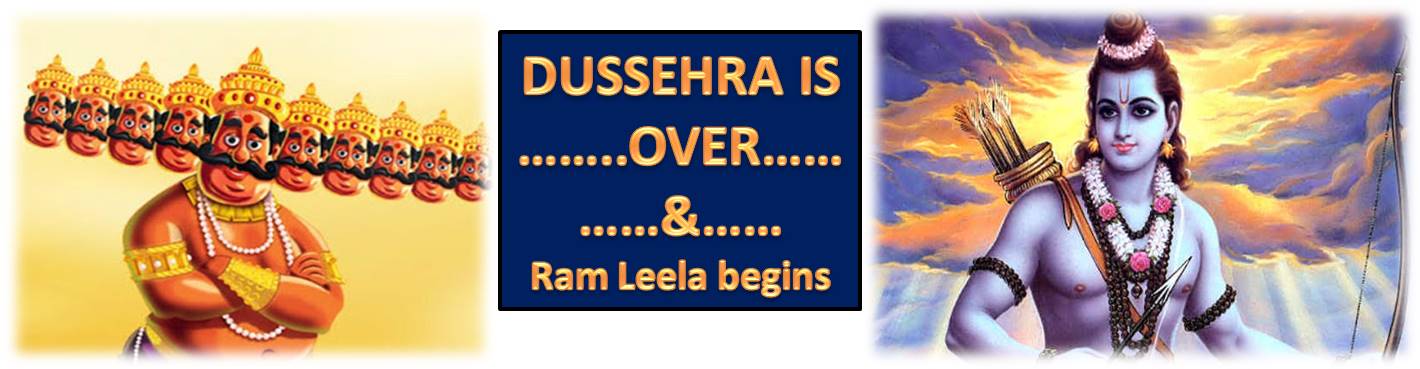 Every year, the festivities of Dussehra end with the effigy of Ravana being burnt. Since ages we have been told that this is symbolic of the Victory of “Good” over “Evil”. A nation which doesn’t get tired of celebrating festivals looks forward to this with lot of anxiety. The economics of this festival alone runs into billions of dollars, literally. No festival lasts so long.
Ramleela is staged across the Northern parts of India, during the same period. People throng to the pandals to worship the deity during the day and visit the Ramleela grounds. The festive fervor continues unabated during the 09 days. Vijay Dashami comes to an end with the demon [although some desist him to be called so] Ravana’s effigy being burnt. End of Dussehra also signals the entry of winter which lasts till Feb March of the subsequent year.
People slowly start getting into welcoming goddess Lakshmi and Lord Ram takes a back seat. But it seems this is not going to be the ritual at least this year….Ram and Ramayana will be enacted till the end of UP elections in 2017. At least that is what one can make out of the political barbs which are being dished out to the people daily. The voices are becoming shriller by the day. This seems to be some, Olympics of the sort for the political class, with the sole objective to prove who is closer to Ram. Parks, Museums are being announced. TV debates are becoming interesting. One cannot but leave this issue in UP if one has to take active part at the hustings.
Just look at the venomous outbursts, I really wonder whether, Ravana ever used such words. History also portrays him as man of values; he didn’t harm Sita, despite keeping her in captivity. It seems he played by the rules. He was very kind to Ram even during his last breath, This has been testified by Devdutt [in First published in Asian Age and Deccan Chroncile, on 27 Sept 2009 as ‘The Wisdom of Ravan’
He writes and I quote “The story goes that after firing the fatal arrow on the battlefield of Lanka, Ram told his brother, Lakshman, “Go to Ravan quickly before he dies and request him to share whatever knowledge he can. A brute he may be, but he is also a great scholar.” The obedient Lakshman rushed across the battlefield to Ravan’s side and whispered in his ears, “Demon-king, do not let your knowledge die with you. Share it with us and wash away your sins.” Ravan responded by simply turning away. An angry Lakshman went back to Ram, “He is as arrogant as he always was, too proud to share anything.” Ram comforted his brother and asked him softly, “Where did you stand while asking Ravan for knowledge?” “Next to his head so that I hear what he had to say clearly.” Ram smiled, placed his bow on the ground and walked to where Ravan lay. Lakshman watched in astonishment as his divine brother knelt at Ravan’s feet. With palms joined, with extreme humility, Ram said, “Lord of Lanka, you abducted my wife, a terrible crime for which I have been forced to punish you. Now, you are no more my enemy. I bow to you and request you to share your wisdom with me. Please do that for if you die without doing so, all your wisdom will be lost forever to the world.” To Lakshman’s surprise, Ravan opened his eyes and raised his arms to salute Ram, “If only I had more time as your teacher than as your enemy. Standing at my feet as a student should, unlike your rude younger brother, you are a worthy recipient of my knowledge. I have very little time so I cannot share much but let me tell you one important lesson I have learnt in my life. Things that are bad for you seduce you easily; you run towards them impatiently. But things that are actually good for you, fail to attract you; you shun them creatively, finding powerful excuses to justify your procrastination. That is why I was impatient to abduct Sita but avoided meeting you. This is the wisdom of my life, Ram. My last words. I give it to you.” With these words, Ravan died.
Look at the humility of Lord Rama, he never uttered any word which would hurt Ravan, who has kidnapped his wife, and here I am forced to think, where all the humility has gone, we call Rama the Maryada Purshottam, and do not follow any Maryada in choosing words.
Is it sheer coincidence that, every time during the UP election the issue of temple comes to fore and then after the results, the issue goes to back burner.
What started with development, gave way to Surgical Strikes and then slowly to Ram. Almost all parties have used god in one way or the other. So as India braces for hostile relations with its neighbors, especially Pakistan and as winter approaches, internally the temperature will be kept high, Courtesy Ram.
It is a general saying in India that, after you have exhausted all your options, you should leave the consequences to God, here it seems even before the battle parties have left it to god.
No war in the history has been won without a general; such seems to be the internal bickering in the ruling party that they have sighed away from declaring their General in the UP elections.
I just hope sanity will prevail and temperatures will be brought down, BJP has an excellent opportunity to produce performance of SP government and corner them. They can ask the performance of each district and expose them, do not understand why they have chosen to invoke the name of Ram.
Of all the Ramleela, this one is going to be an interesting Leela of the sorts and let’s see who triumphs.
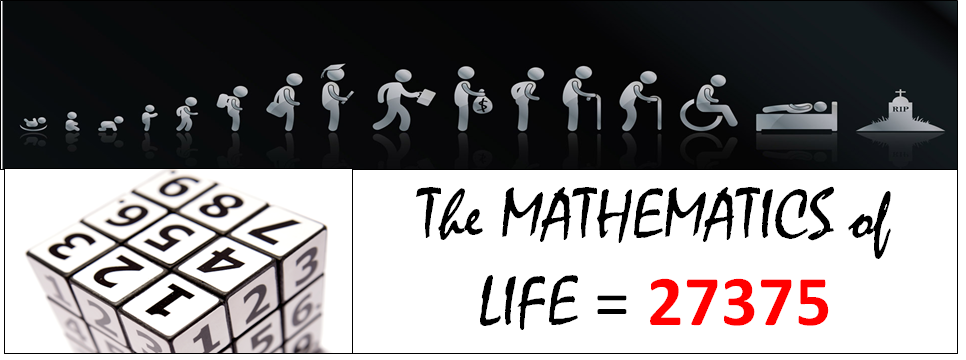
That Mathematics baffles many is a universal truth, yet this simple and innocuous equation of “The Mathematics of life = 27375” has been baffling me the most and remained a mystery for me till the other day. I had read about the same in some Journals as a passive reference but never gave a deep thought about, what it could point to till I placed my hands on an article titled, “Average life expectancy” of human beings in various countries, which unraveled the mystery.
If the average life expectancy of any human beings in a country is 75, [may be more may be less] then the number of days he or she lives is 27375 days. Now, this is no-brainer, 365 days multiplied by 75. So what, everyone has these numbers of days in his account.
The real challenge is how we decide to use these 27375 numbers of days…… I looked at how my own life had been so far and what was in store for me. I choose to look at my life as being made of three Phases.
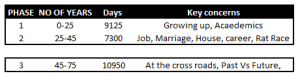
The first phase from birth to 25 years or 9125 days got exhausted in Growing up, academics etc….yes it would not be out of place to admit that, lucky are those who have a disciplined life in this phase, for this lays a strong foundation for the other two.
Phase 2 from 25 to 45 years or 7300 days got exhausted in struggle for Job, settling in life, facing the challenges and travails of life as it unfolded, sometimes in rainbow colors and at some other time in purely black and white form. Now at the third Phase, as would be the case with many of my peers, when I look back at life I find myself standing at cross roads. Having exhausted 16425 days and left with 10950 days more [if lucky], I am undecided whether to spend time analyzing how the days have gone or look optimistically at how to utilize the balance………as my mind and heart engage in a fierce debate, I am reminded of a nice quote,
Got a dream? Run towards it.
Can’t run? Walk step by step
Can’t do that either? Just crawl
Can’t Crawl? Then look in the right direction
Standing @ crossroads, I am still debating like many, if at all I had a dream and if I had one, whether I ran towards it or walked or crawled or still trying to find the right direction of dream which got lost somewhere in the labyrinth of many challenges that life throws.
Note: Have used the picture in net to give shape to my thoughts. Take this opportunity to acknowledge the efforts of those who uploaded the same
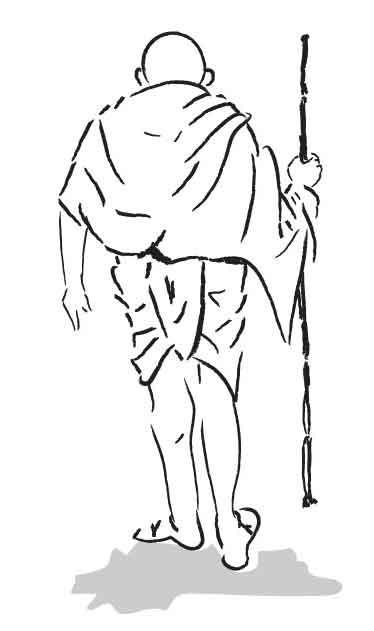
First they ignore you, then they laugh at you, then they fight you, then you win.” How true have these words, said long back against the backdrop freedom struggle by Mahatma Gandhi, proved to be true for AAP…….every word of what Gandhi said, explains the circumstance in which AAP finds itself.
Political interest and awareness is in the Indian blood, the eagerness with which we wait to reward or punish parties at the hustings makes some of the social scientist go tizzy. Everybody who knows something or the other about the Indian politics including me, went through the same emotions as outlined in the words of Mahatma, initially we all ignored AAP as an aberration, some of their acts were laughed and jeered at, some argued and rubbished their claims to cleanse the rot that had set in. Even, his mentor disapproved of his adventure or misadventure into politics. AAP proved all their detractors wrong, as the nation waited with baited breath, history was being unfolded before their eyes on December 8th, 2013. Before one could realise the repercussions of this phenomenon, it was too late, AAP had won the hearts of millions and forced all those who initially rubbished them as a media phenomenon, to take note of them seriously……some of the comments made by the leading politicians from both the mainstream parties were and are still not in good taste. This corroborated what the Mahatma said; every letter and every word of what he said came true.
 The adjacent illustration (source google images), though used extensively in the Management class rooms to teach how change is mocked in the beginning, and the various stages it goes through before being accepted, sums up the emotions, all of us went through.……..Most of us are still wondering, is AAP just a blip or an aberration or precursor to a big change that is going to swarm the Indian political diaspora.
Even before the action has unfolded, some of us have started writing the obituary. Whatever may be outcome, one thing cannot be denied, if what unfolded on December 8th, is a trailer, the full movie in 2014, definitely promises to be a thriller.
I take this opportunity to wish “A very happy and Prosperous New Year” to all my well-wishers who have taken time to go through my blogs, critically appreciated it, and encouraged me with their suggestion.
Looking forward to this continued support in ensuing year too……..
Eshwar.
Wednesday, 25 December 2013
Driving back home on a weekend, whilst I was hopping from one FM Radio Channel to the other, this song being played on one of the Channels caught my attention……..Juhi Ki Kali Meri Laadli , (from the movie Dil Ek Mandir – 1963), sung by Suman Kalyanpur with the lyric penned by Shailendra. It was that of a mother praising her little daughter with motherly affection, http://www.youtube.com/watch?v=5F_hBjEbtMs
As a father of growing daughter, I am deeply perturbed. I and am sure, like me all those who have this bundle of joy called daughter across the nation are. At this moment my sympathies are with the family of the photographer who was subjected to such inhuman and barbaric act….i have been deeply contemplating since the Delhi incident, and was believing like many and hoping against hope, that against a back drop of such a nation wide outrage against the incident, it must have stirred the conscience of many. But, the Mumbai incident proved me wrong. It seems nothing has changed.
Trial is going on in the Delhi case and the Nation is eagerly waiting to see the outcome. Like all the fathers, I am also keen to know how and what kind of Justice gets meted to the family and to the soul of departed. Already, we are seeing some accused being protected or an attempt being made under the garb of being juvenile. As a nation we are sick of hearing this old trite, “Justice will be done and law will take its course….but which course we don’t know”.
It is told and I quote from TOI, ” The police, after attending Monday’s proceedings, told the media outside the Juvenile Justice Board that the verdict has been deferred till August 31 as the apex court has reserved its order on the maintainability of the PIL.
This is the fourth time that the pronouncement of verdict has been deferred by the board since July 11. ”
Now, why the delay in meting out the verdict, the crime took place on 16th of Dec 2012, it is almost 9 months, I understand, we are torn between the technical nuances. We are fighting to interpret that “mental and intellectual maturity” of minor offender be considered instead of the age limit of 18 years while fixing their culpability. I fail to understand what mental state and intellectual maturity would have encouraged the juvenile in the instance to commit such a dastardly act.
Sad and Sullen, i was introspecting, where does this perpetrators get the fuel and fodder from, which forces them to go to any extreme to satisfy their lust laced with anger…other wise how could one explain the barbaric mindset. There could be thousand of triggers. A couple of weeks later, as my vehicle stopped at the usual busy Junctions…..my roving mind scanned surroundings outside and my eyes could not move away from the poster of a Bollywood movie. I am not a regular movie buff….but this poster on boundary wall, besides which many school going children, parents and others were moving with ease, gave me jitters, somehow i was uncomfortable.

This was a poster from the movie “NASHA”…..traffic moved and i also got immersed in the rat race. However, the poster was still doing rounds in my mind. I was thinking ,if it was on my mind even after week, what impact it would be having, on the many a young minds who have to pass by it daily. I failed to understand, what was the director trying to communicate and is there no body who looks into it. The poster definitely was indeed not encouraging one to be patriotic or show respect to opposite sex, further, what is the NASHA, it is encouraging one to have. Aren’t we able to see a correlation between the crimes on girl child or women and these as one of the reasons, I am not staying this is the only reason, but certainly will not agree if someone says these are reasons small enough to be ignored.
We have a CENSOR board working under the aegis of Ministry of Information and Technolgy, a visit to their website gives their Vision, which says and I quote” To ensure the good and healthy entertainment in accordance with the provisions of the Cinematograph Act 1952 and the Cinematograph (Certification) Rules 1983, and one of their 06 missions outlined states , ” To ensure healthy entertainment, recreation and education to the public”. Now, is this anyway healthy entertainment by any means or what is this trying to educate.
 Can’t the CENSOR board, if it is working towards healthy entertainment as it claims, come before the public after every approval it grants and tell the public why have they given permission to a particular film and why they have stopped it. Now, imagine, poster such as this remaining on walls for weeks together….can’t the government and Ministry of Information and Broadcasting take note of the same. Further, the poster had a tag line, from makers of JISM…….another titillating tile….curiosity drove me to see what it was. I think why people are not protesting against such poster, why others, i was thinking what stops me also from joining the groups working towards bringing decency in public life OR have we come to accept these as regular.
It is not that we [ Govt] do not have the where withal. There is a huge machinery, which can monitor the same. I feel, just like way we submit documents to various government agencies, makers of FILM should be made mandatory to submit poster of the film that would be displayed across the nation. Is it impossible to implement this simple measure. Why can’t each poster displayed across the country have a stamp and seal of “approved by CENSOR board for public display”. On the songs front too we are not better off, the excessive emphasis on the ooomps and the pelvic gyrations make some of the songs not worth watching and humming.
Imagine, if this is a situation in a metro, what could be small towns and villages. Is CENSOR board doing what it is supposed to do, if so then are these vetted by the BOARD. Are they not answerable to the citizens. These and many other such issues are currently agitating the mind of ordinary denizens across the country.
I reiterate, it is not the only reason, but surely would argue that, it is one of the triggers and a strong trigger. I know there is lot of opposition to such views, just like the way when Mumbai’s municipal council passed a resolution barring stores from displaying scantily-clad mannequins outside city shops. Ask the actors, pat they would be reply, it is the demand of the scene in the film, as if the entire film hinged on her wearing the skimpy clothes. Ask the producer, he would say his movies reflects the society, as if the women in this country are wearing such clads. Ask the Government, they seem to be clueless.
Mean while lets wait for the Juvenile Board to pass its opinion in the Delhi Rape case….to see which course this discussion takes.
The views expressed here are purely of the writer and one is at will to agree or disagree.
 MNC’s, the very name conjures a, different kind of image in the minds of millions of Indians aspiring to be its part one day. We have all grown up with notion that, If you have to work, it has to be an MNC. Stories of their culture, Employee Practices, Training and development, Perks, Salaries, Travel, Rewards and Recognition… you name them, it was believed, at least I used to believe, MNC had them all. The pride with which neighbours and friends used to tell; my son or friend works for MNC invariably had an element of awe built into it. Am talking of 80’s n 90’s, while as a school going child, I also use to hear such stories. I was also bitten by the bug of MNC’s and always ranted, KAAM KARNA HAI TO MULTINATIONALS MEY” …….
Unverified, stories of practices in MNC’s used to do round in large numbers and these stories further strengthened the notion that, if you have not worked in MNC, life was not worth it ( sounds harsh, but that’s what the reality was for some us).
But, who are these MNC’s and what is their origin. A Multinational corporation is one which is registered in more than one country or that has operations in more than one country. It is a large corporation which both produces and sells goods or services in various countries. It can also be referred to as an international corporation. They play an important role in globalization. Arguably, the first multinational business organization was the Knights Templar, founded in 1120; this organization existed for nearly two centuries. During middle age, it was officially indorsed by Catholic Church around 1129, and was defunct by 1312. After that came the British East India Company in 1600 was originally chartered as and then the Dutch East India Company, founded March 20, 1602, which would become the largest company in the world for nearly 200 years……………and then there has been a deluge of sort, …… some of these MNC are so deeply embedded in the Indian diaspora that, they have seen their fortunes rise and fall with the fortunes of India. [Refer to the picture below and Check for May 2013 issue of Business Today for better insights: MNC’s that succeeded against all odds by Anand Adhikari]

Yes even today, while as I am writing this piece someone somewhere is dreaming to work for an MNC. But, the moot questions remains, are there enough of them, with the practices which attract the youngsters in droves or is it that the list to choose from still remains the same as it was couple of decades before. Yes, we have certainly added lot of them and they have without doubt brought some good practices, yet during the same time, lot of SO CALLED MNC’s have also mushroomed all over the country. These so called MNC’s have only one thing in common with the deeply entrenched MNC’s in India, their economic definitions remains the same. That’s the only commonality and nothing else. Run not by LEADERS but MANAGERS, these so called MNC’s have done lot of harm to the image of genuine ones. Practices catering to the Flavour of the seasons than a genuine interest, Violations of Labour laws, only striving to get Profits and More Profits, squeezing the employees to his last sweat, not looking at the working conditions in India, seeing investing in people as a COST, you can go on and on, the list seems endless
Invest to grow business and profits has been replaced with reduce cost and grow bottom-line. GROW at any COST has become the vision and mission. Rest all talk remains a hoax and is confined to defend the MNC status. Slight change in Economic conditions of the nation in which they operate and you start seeing the true colour of these so called MNC’s. With very little or practically no social security or investment in any aspects of business, viz Marketing, R&D, Advertisement, Brand building, Employee development, these MNC’s expect super profits and expect their employees to be ever informed, agile, energetic, be proactive and without airing their problems and difficulties perform like Super Man. If they bring revenues they are gems or else duds.
Sometimes, in the so called MNC’s one is forced to take some actions which otherwise the employee would not have done so, be it lay off, be it balance sheet or P&L dressing to make it look healthy, and so on…..but, despite all this, is there a way out……the answer is yes. You just need to clearly spell to your principals what kind of environment you are operating in. On earth we all breath OXYGEN, but one day if we are successful in putting mankind on MARS or any other planet, am sure you cannot live for more than a day, for the conditions are totally different. This basic aspect if these so called MNC understand, I think they can definitely contribute a lot to themselves and their principals.
People join MNC with a lot of hope and aspiration that they would have a wonderful career in the company, but this honey moon does not last for a long time…it is only the first month that you are seen as an investment, if things do not go as desired, you are a cost. Here some of the Indian companies have done exceedingly well when compared to these so called MNC’s. Rampant and greedy profiteering without any Value Addition whatsoever by these MNC’s increases the Cost of Production of their clients and subsequently for their end customers.
Multinationals are learning that many different India’s exist within the subcontinent. The big differences—the haves and have-nots, languages, literacy, and geography (including the urban–rural divide)—make it difficult for a global brand to satisfy all of the country’s consumers. Multinationals also face the challenge of low-cost local competitors.
Indian consumers demand sophisticated products and services found in the West, but at lower prices. A one-minute call from a mobile phone, for instance, costs one to two cents in India, much less than it does in the United States.
THE REAL MULTINATIONALS…. Are they there…..Yes, they are, and they are growing by adopting one single mantra…..they are investing and growing, their investment shows the commitment and their growth is a resultant of their commitment. These Multinationals are to be found in each and every aspect of the industrial arena, be it FMCG, Capital Goods, Health Care etc..etc however these are very few in number to cater to the desires of hundreds and thousands of Indians.
Some of the practices of the so called MNC’s are forcing the working executives to rethink their decision….some feel, it is better to work for an Indian Home grown company rather than such MNC’s.
In the end , I am providing a link to an excellent presentation “PROFITS BEFORE PEOPLE” by BRUCE KASANOFF which I can across while preparing for this blog. Trust you would find it interesting.
http://www.slideshare.net/slideshow/embed_code/25024817#
The views expressed above are purely mine, readers are at will to echo or not echo them.

